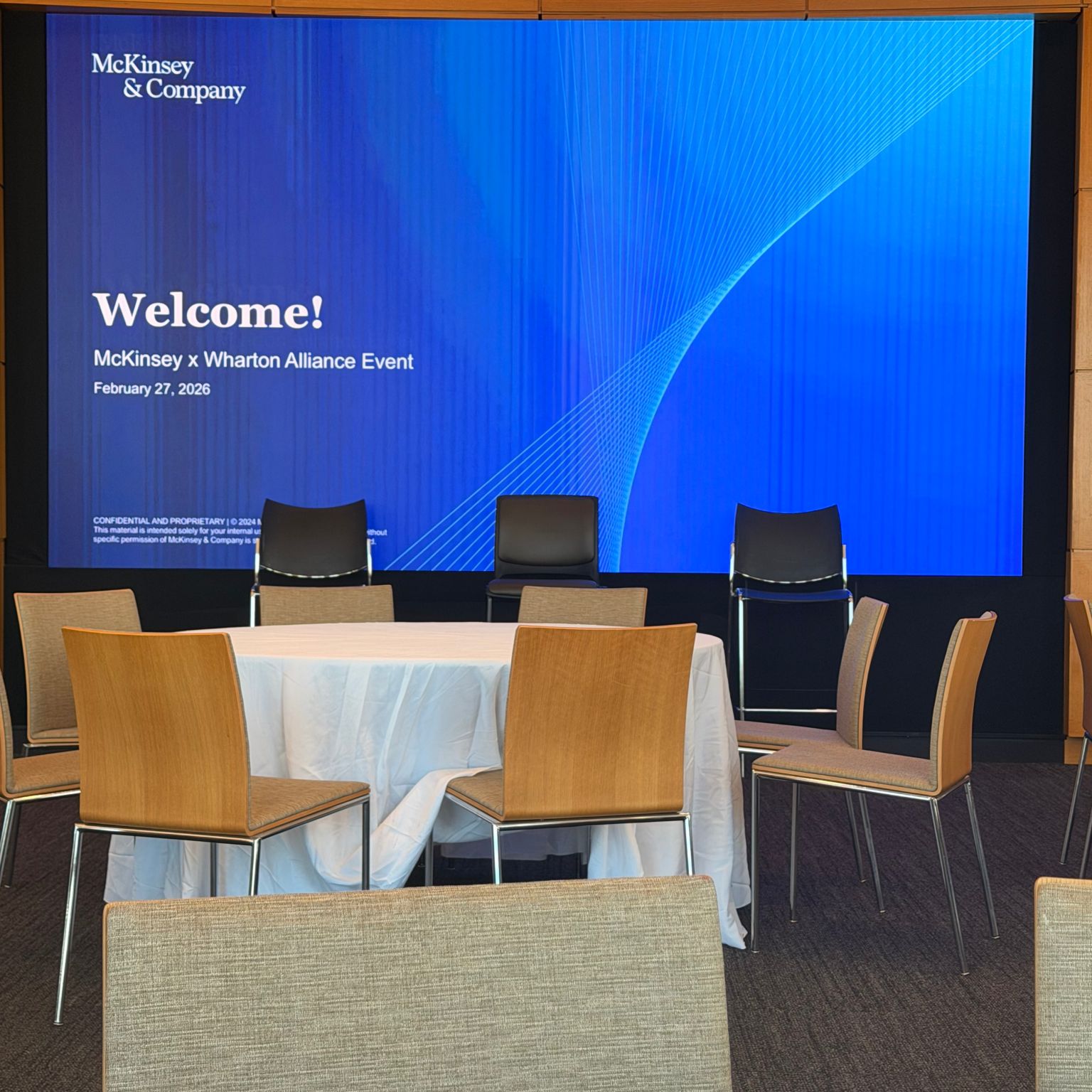
Developed a self-funding ESG transformation strategy for a $240M Bangladeshi garment manufacturer — turning $15.4M in operational waste into the engine for labor compliance, environmental upgrades, and commercial resilience. Presented live at Wharton to McKinsey & Company judges.
The 12th Annual Wharton Alliance Diversity Case Competition brought together top graduate and undergraduate teams from across the country. Sponsored by McKinsey & Company, BCG, Capital One, L.E.K. Consulting, and Warburg Pincus, the competition challenged teams to develop actionable strategies addressing both competitiveness and social impact for a garment manufacturer facing an ESG crisis.
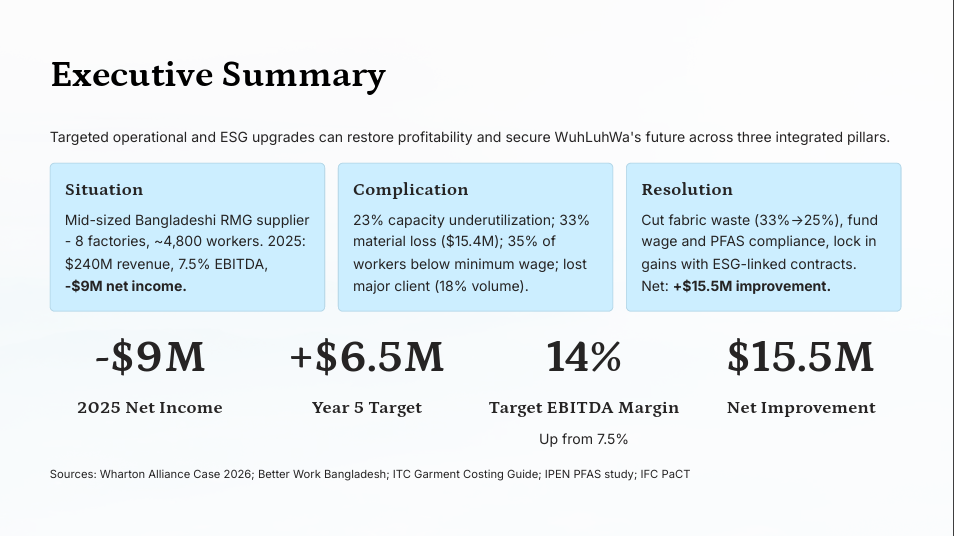
WuhLuhWa Apparel Ltd., a mid-sized Bangladeshi garment manufacturer with 8 factories and 4,800 workers, faced three simultaneous pressures threatening its survival. Teams had 48 hours from case release to deck submission, with finalists presenting live to a McKinsey-led judging panel.
33% material loss rate (vs. 20% industry benchmark) = $15.4M annual waste. 23% capacity underutilization after losing a major client representing 18% of volume.
Workers (35%) paid below legal minimum wage. 60% report workplace threats. Only 5% female supervisors despite 64% female workforce. 30% working illegal overtime.
100% of garments contain PFAS. EU PFAS bans taking effect July 2026. $70–90M in EU market access at risk. 87% of regional surface water contaminated.
"Profitability and responsibility aren't a trade-off — they're the same decision."
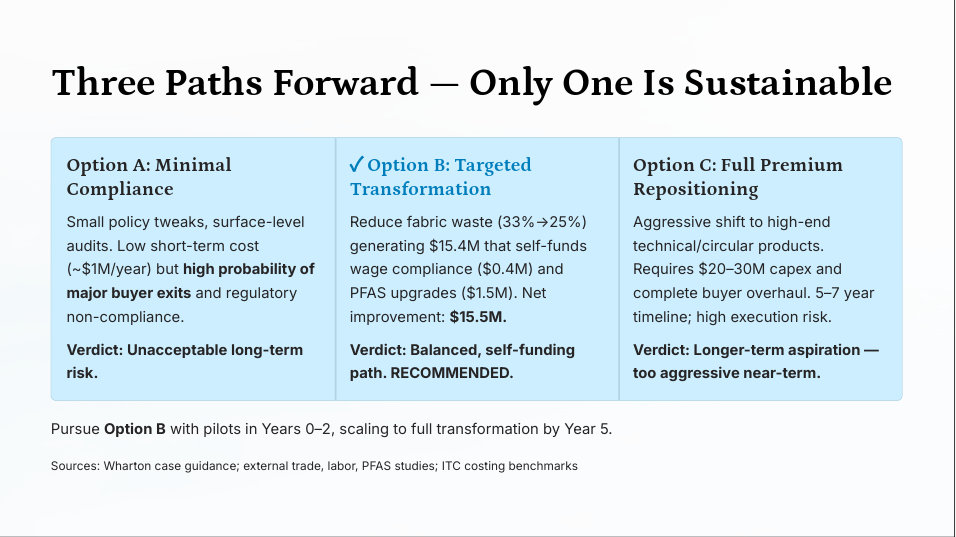
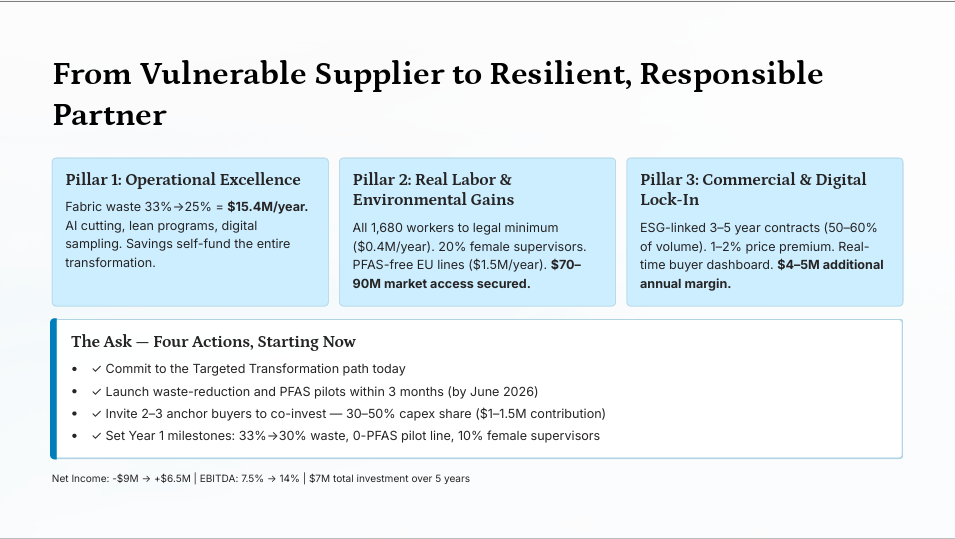
We evaluated three strategic paths: minimal compliance (too risky), targeted transformation (self-funding), and full premium repositioning (too capital-intensive). Our recommended Option B uses operational waste savings to entirely self-fund ESG compliance — requiring no external capital despite a $100M debt load.
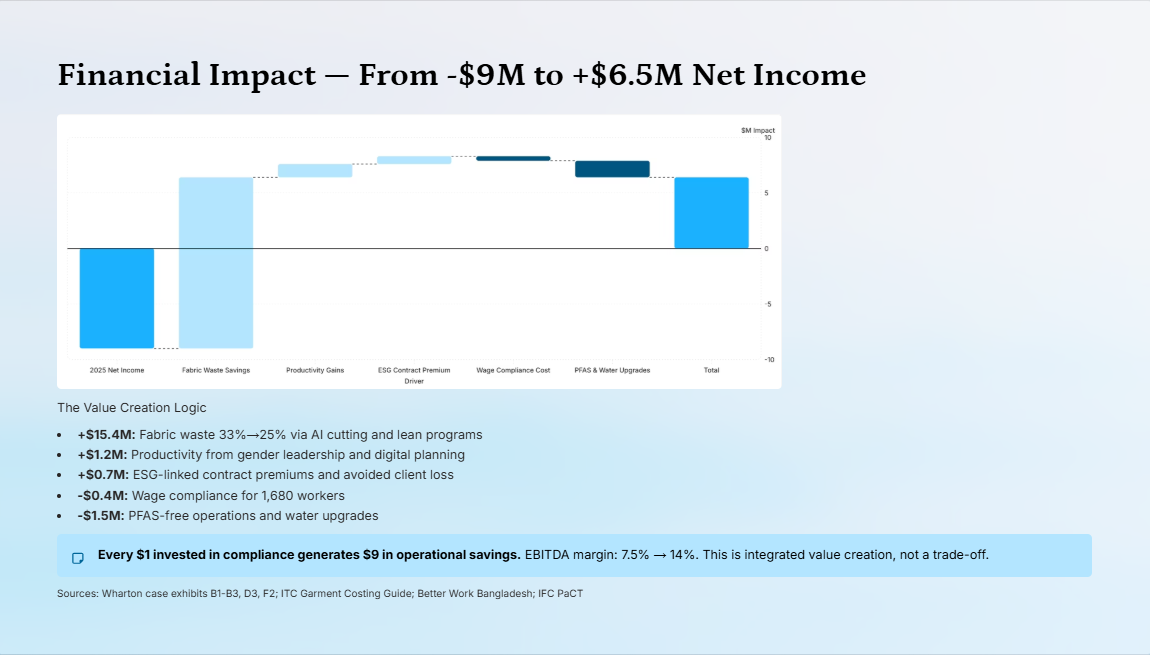
Reduce fabric waste from 33% → 25% via AI-assisted cutting (Gerber, Optitex), lean/5S programs, and 3D digital sampling (CLO, Browzwear). $1M investment unlocks $15.4M annual savings at scale.
$15.4M/year savingsClose the wage gap for 1,680 workers at $0.4M/year (0.17% of revenue). Scale female supervisors from 5% → 20% through a GEAR-style $300K intervention yielding $1.2M+ productivity gains.
$300K → $1.2M+ return$2.5M capex + $1M/year ongoing for chemical substitution and water treatment upgrades. Protects $70–90M in EU market access as France, Denmark, and EU-wide PFAS bans take effect.
$1.5M/yr insures $70–90MOur deck followed SCQA (Situation-Complication-Question-Answer) structure with answer-first slide titles, quantified assertions, and footnoted external sources. We delivered a 15-minute live presentation followed by 5 minutes of judge Q&A from McKinsey analysts.
Operational waste savings fund 100% of ESG compliance costs — no external capital required despite the company's $100M debt load. This was the central innovation of our strategy.
80% of workers report job satisfaction despite severe labor violations. We reframed this as "economic dependence, not well-being" — the insight that reshaped the entire labor strategy.
A $300K GEAR-style intervention returns $1.2M+ in productivity gains — framed as a commercial lever, not CSR. Scaling female supervisors from 5% to 20% drives measurable output.
Compliance milestones contractually linked to 1–2% buyer premiums via 3–5 year ESG-linked contracts, turning a cost center into $2.4–4.8M additional annual revenue.
MS Business Information Technology, Drexel University · Strategy, Financial Modeling, Deck Design
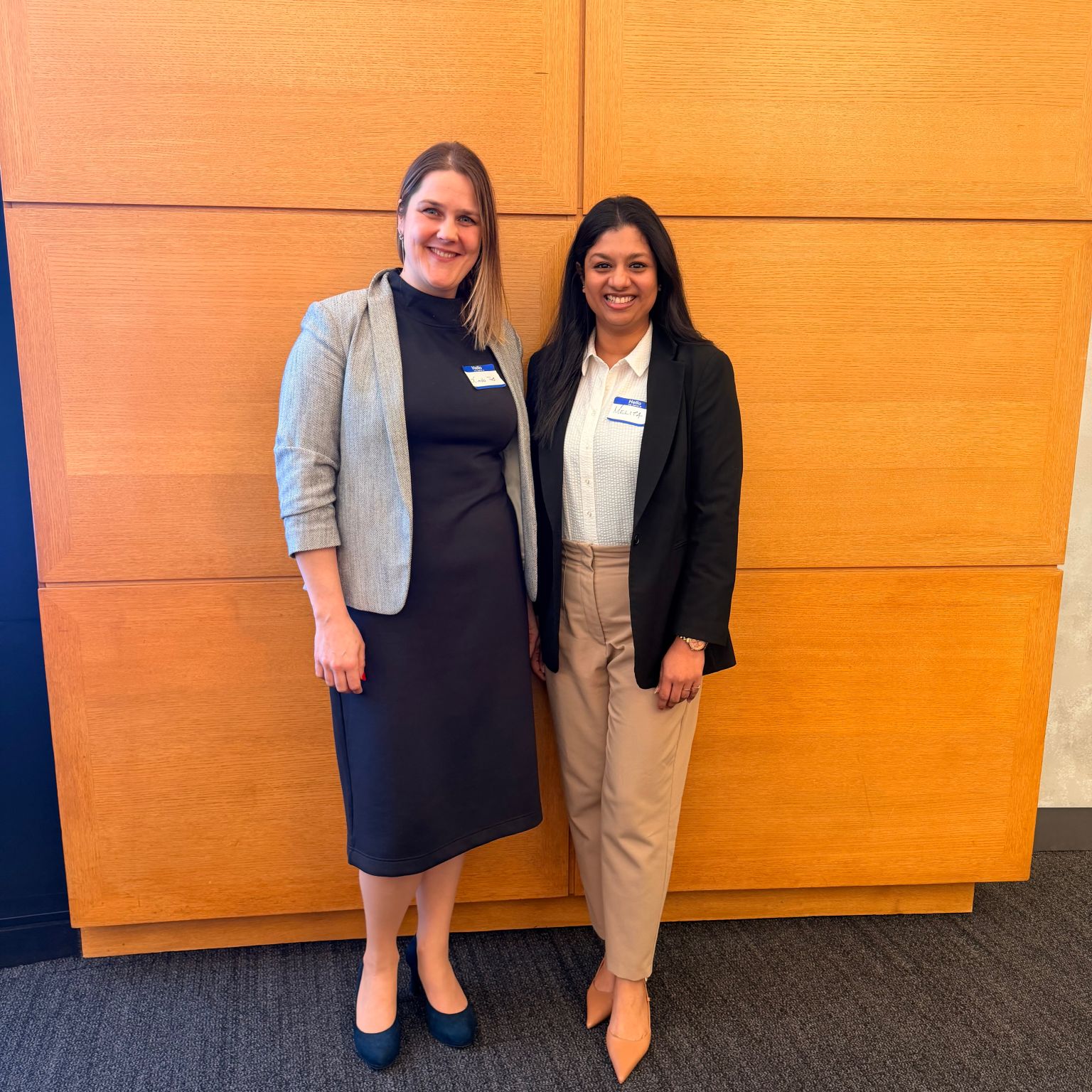
Teammate · Research, ESG Analysis, Presentation Delivery
Built the full P&L waterfall and 5-year ROI model
Designed the three-pillar self-funding framework
20-slide McKinsey-structure presentation
AI cutting, 3D sampling, ESG dashboard strategy
Buyer contract model tying premiums to milestones
Co-presented to McKinsey judges + handled Q&A